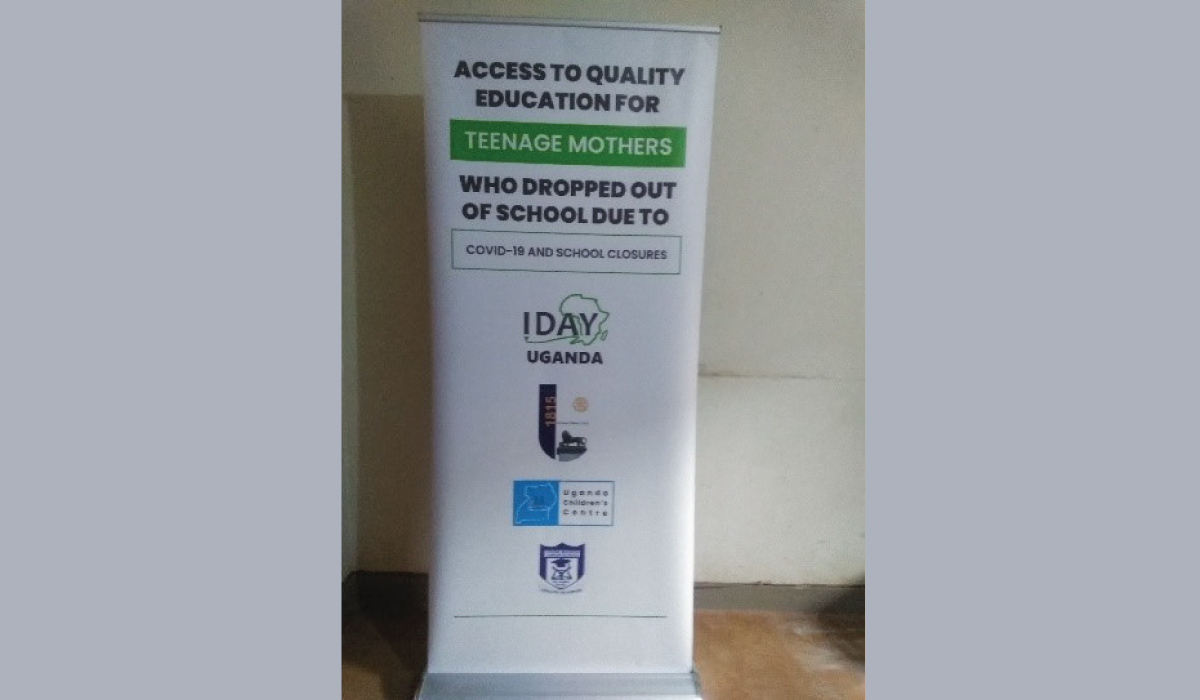
Uganda Children’s Centre under the coalition of IDAY Uganda joined hands with Divine Mission Junior School to implement a project titled “Access to quality education for teenage mothers dropped out of school due to Covid-19 and school closures”. This initiative will be implemented in Makindye Division one of the five administrative divisions of Kampala, the capital city of Uganda. The project is funded by the Rotary Club of Braine-L’Alleud based in Belgium, while monitoring and evaluation by IDAY Uganda and IDAY International respectively. The project will identify and mobilize teenage mother drop outs determined to go back to formal schooling or attain a sustainable vocational skill.
The impact of COVID-19 lockdowns on the educational sector in Uganda left many school going children unable to attend school again. According to Ministry of education and sports, nearly 650,000 teen pregnancies were recorded between 2020 and last year during the coronavirus lockdown.
In a study conducted by United Nations Population Fund, a total of 354,736 teenage pregnancies were registered in 2020, while 290,219 pregnancies were recorded between January and September 2021. On average, 32,000 teenage pregnancies were recorded per month. Without education, these youngsters would be condemned out of the social system of skilling, preparation for employment, entrepreneurship and better social economic status.
The government allowed schools to reopen on 10th January 2022 with thousands of pregnant teenage girls allowed to continue with school amidst resistance from conservative education administrators. The government insists that the right to education is constitutional, irrespective of any economic and social standing. However, most Headteachers disagree with the decision to allow pregnant learners in classrooms.
Most schools preferred having their girls stay in boarding sections because majority had grown up and were at risk of being lured into sexual acts. However, most parents and guardians do not support this idea because boarding sections are expensive yet they do not have the funds.
Key results of the project will include improving teenage mothers’ health through providing reproductive sexual health rights education, equipping teenagers with employable market-oriented trade skills, increased information sharing through convening community meetings to disseminate laws and policies that protect school going adolescent girls, and increased number of teenagers completing their cycle of education.
The teenagers will be mobilized using existing social structures such as local leaders, religious leaders and community committees. The training will be conducted at UCC vocational training centre and Divine mission junior school. The implementation team will ensure sustainability is achieved through establishing strong partnerships and networks with schools, local leaders, religious leaders, NGOs and the government to continue building capacities of the teenagers and youths to prevent and protect them from sexual abuse and violence.